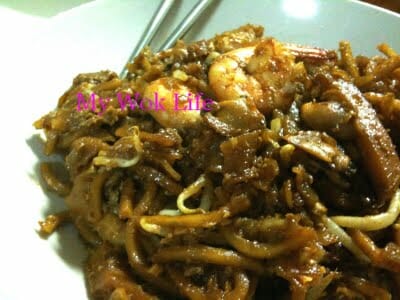

“Singapore-style Char Kway Teow (with yellow noodle) you may cook and taste from home!”
Char kway teow, which means “fried flat rice noodles“, this is one of the popular hawker food in Singapore. It has also been termed as unhealthy food due to its excessive oil and/ or pork lard used in cooking this dish. It is yet one of the famous local delicacies, for its extra flavoursome taste.
 Singapore-style fried kway teow is not cooked with only one noodle type, but often combine with cooked yellow noodle (round and thin yellow strands) in the dish. Not sure why, but you tends to experience better mouthfeel with the combination. Yes, I loved it!
 Yeah, note also that the kway teow (rice noodle) used for this dish is neither the broad type nor very thin strands. For Singapore’s Char kway teow, the kway teow noodle of this dish should be just about 1cm wide (smile).
There are those dried (hard) types in the dry goods section or ready soften/ pre-cooked types in chilled Asian food products section in major supermarkets, or in Singapore, you may get it from wet markets. Yes, get those ready soften kway teow noodles, to skip the extra steps of soaking and cooking of noodles beforehand. Same goes to yellow noodle, as it should be pre-cooked type available in chilled Asian food products section.
Many people will add chives (韭菜) or scallions (青葱) into Char kway teow, for more flavours and balanced diet (as more green added) as well as better presentation (more colours on it!).
One of my readers, Joe, asked for Fried Kway Teow recipe, and here I am sharing with him, and all!
Ingredients
300 gram of flat rice noodle aka Kway Teow (粿条), loosen the strands
300 gram of cooked round yellow noodle (熟面), loosen the strands
200 – 300 gram of medium-sized prawns, shelled with tail intact
 1 cup of fresh cockles aka “hum” (血蚶), shelled
1 Chinese sweet sausage aka Lap Cheong (腊肠), thinly sliced or cut into strips (*see pic on right)
1 large fish cake, cut into strips
Handful of bean sprout, trimmed
3 medium eggs
3 cloves of garlic, minced
1 – 2 tablespoons of Sambal chili paste
2 tablespoons of fish sauce
2 tablespoon of light soy sauce
2 tablespoon of dark soy sauce
2 tablespoons of black sweet sauce (黑甜酱) or sugar (*Adjust amount to your desired sweet taste)
1 tablespoon of tamarind juice (*Juice from a lump of tamarind/ assam seeds paste mixed into 1 – 2 tablespoons of water. Discard seeds and use only 1 – 2 tablespoons of juice.)
Pinch of salt to taste (*If more briny taste preferred)
2 – 3 tablespoons of water
6 tablespoons of peanut/ vegatable oil
Optional:
Chives, cut into 2 inches long, lengthwise
Method
1) Heat wok with 3 tablespoon of oil over high flame. Add garlic and stir fry till fragrant and golden browned. Add Chinese sausage, and stir fry till fragrant and sausage appears glossy (not burnt). Add in fish cake and prawns, and stir fry till almost cooked. Reduce heat to medium fire, and move the ingredients to one side of the wok.
2) Add sambal chili paste into the cleared space (in the wok), and stir fry for 10 seconds. Then, add kway teow and yellow noodle into the wok, followed by water. Stir fry noodles to combine well with chilli paste. Then, move the ingredients back and combine with noodles. Often scrape the surface of the wok to minimize sticking.
3) Add fish sauce, light soy sauce and dark soy sauce. Stir fry vigorously to combine well.
4) Thereafter, scoop the noodles and other side ingredients, all to one side of the wok, leave the centre of the wok empty, and add another 3 tablespoons of oil. When oil is heated, crack in eggs. Break up the eggs with the wok spatula, and then, return the noodles and other ingredients to the centre of the wok, and coat well with the eggs. Add black sweet sauce (or sugar) and stir fry to combine. Then, add in tamarind juice in one circular motion and stir fry again to combine well.
Taste a little of it, sprinkle some salt and stir fry to combine well, if not salty enough.
5) Now, add in bean sprout (and chive, if opted for) and stir fry for 10 seconds. Lastly, add in fresh cockles and stir fry for just a few seconds, before heat off. Serve hot.
1 serving of fried kway teow counts as much as 680kcal! So, eat moderately.
 Secret tricks: Add tamarind juice is to neutralise its greasy taste, and it enhances the overall flavour of the dish. It’s not a must, but good to have. Rub the pasty flesh of tamarind out of its seed and mix into water to create tamarind juice. Discard the seeds. Use 1 – 2 tablespoons of the juice, if desired. The choice is yours.. :)
Tips: Char Kway Teow dish has to be cooked quick in action to retain its moist consistency.
* If you do not have any black sweet sauce which used to complement the eating of steamed rice cake (饭馃) or Soon Kueh (笋馃), use sugar.
* Soak cockles in salted water for few hours, it helps to de-shell easier than without soaking.
Living in Melbourne Australia I have tried a lot of kway teow in restaurants.None can come close to
the kway teow I have eaten in
Singapore.Just tried this recipe
and could not believe how easy it
is to cook and how wonderfull it tasted.Thank you!!! You are my saviour for this dish.
Hi,
The pics of Char Kway Teow looks watery which is my favorite type. I like the Char Kwat Teow to be watery instead of dry.
Do you add water? If yes, at which stage?
Thanks,
Steven
Hi nh1870,
No water added, but if you like add it before dishing up, or as long as you find the noodles dry. Just sprinkle will do.
I do believe all the ideas you have introduced to your post.
They are really convincing and will certainly work.
Nonetheless, the posts are too quick for newbies. May you please prolong them a bit from subsequent
time? Thank you for the post.
Hello Home delivery meals,
Thanks for liking my posts and suggestion given.
I would like to take all pleasant suggestions from my readers. However, I do not quite get you on the statements about ” the posts are too quick…” and asking on “prolong them abit…”. Hmmm…. Do you mean I post so fast after one another? Or the recipes (methods listed) are too brief/ short and not detailed or clear enough for your reading? Please enlighten me for further improvement. :)
hi! i have tasted char kway teow twice when we visited singapore and i can.still remember the delicious taste of it. i would like to try cooking your recipe.
can you suggest product brands for the following sauces that i can buy in singapore:
light soy sauce
dark soy sauce
dark sweet sauce
thank you! :-)
Hi Julie,
Thank you for visiting my website and certainly like you to try out my recipe! :)
As for your queries on the product brands for the sauce, I have no particular brand to recommend you at the moment, in fact. As I am still trying out various brands to get the few best quality and taste of those in the markets, I would now suggest you to get any brand you like or seems pleasant to you with the following criteria, if this does help you to make your choice at the moment:
1) Choose among the few most popular brands in the market, if you do not have a single clue on which brand to get.
2) If you could afford, always choose the better quality stating words like Premium, Top grade, Top quality, Superior, and etc. As usually this range of soy sauces made of better quality of ingredients, or taste more flavourful than the usual types. Price would be slightly higher than the standard sauces.
3) For own consumption/ house-cooking, I would also suggest low-salt or no added MSG versions.
4) As for dark sauce, try not to get the sauce that seems diluted or lighter colour. I personally preferred those very thick and ‘black’ sauce for more flavour. For these, go for older brands.
If you really wish to know which brands I am currently having in my kitchen? I can still share with you, but no particular highlights to these. :)
Yuen Chun brand and Tiger brand for dark soy sauce.
Lee Kum Kee brand and Kikomum brand for light soy sauce.
Tai Hwa brand for sweet dark sauce.
Hi can i know your recipe is for how many servings? Thanks!
Hi Nicole, it’s for 3-4 pax
This is great article
Thank you for the recipe
I will try to cook
Hallo Patricia, do you mean Kikoman brand for light soy sauce or Kikomum? thanks
Kikoman brand. :)
When someone writes an post he/she keeps the image of a user
in his/her mind that how a user can know it. So that’s why this article is outstdanding.
Thanks!